Fasting Friends of the Bridegroom During Holy Week
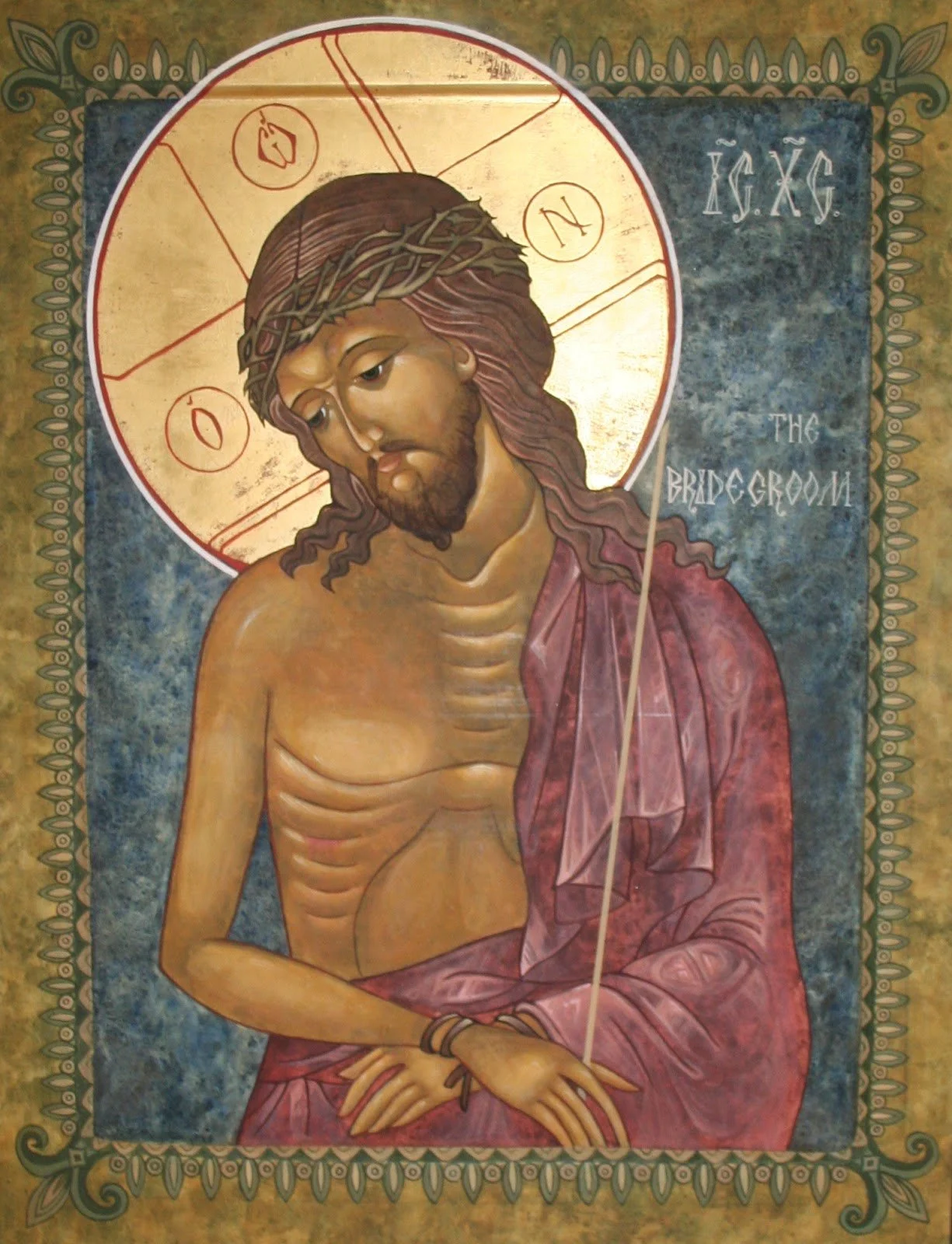
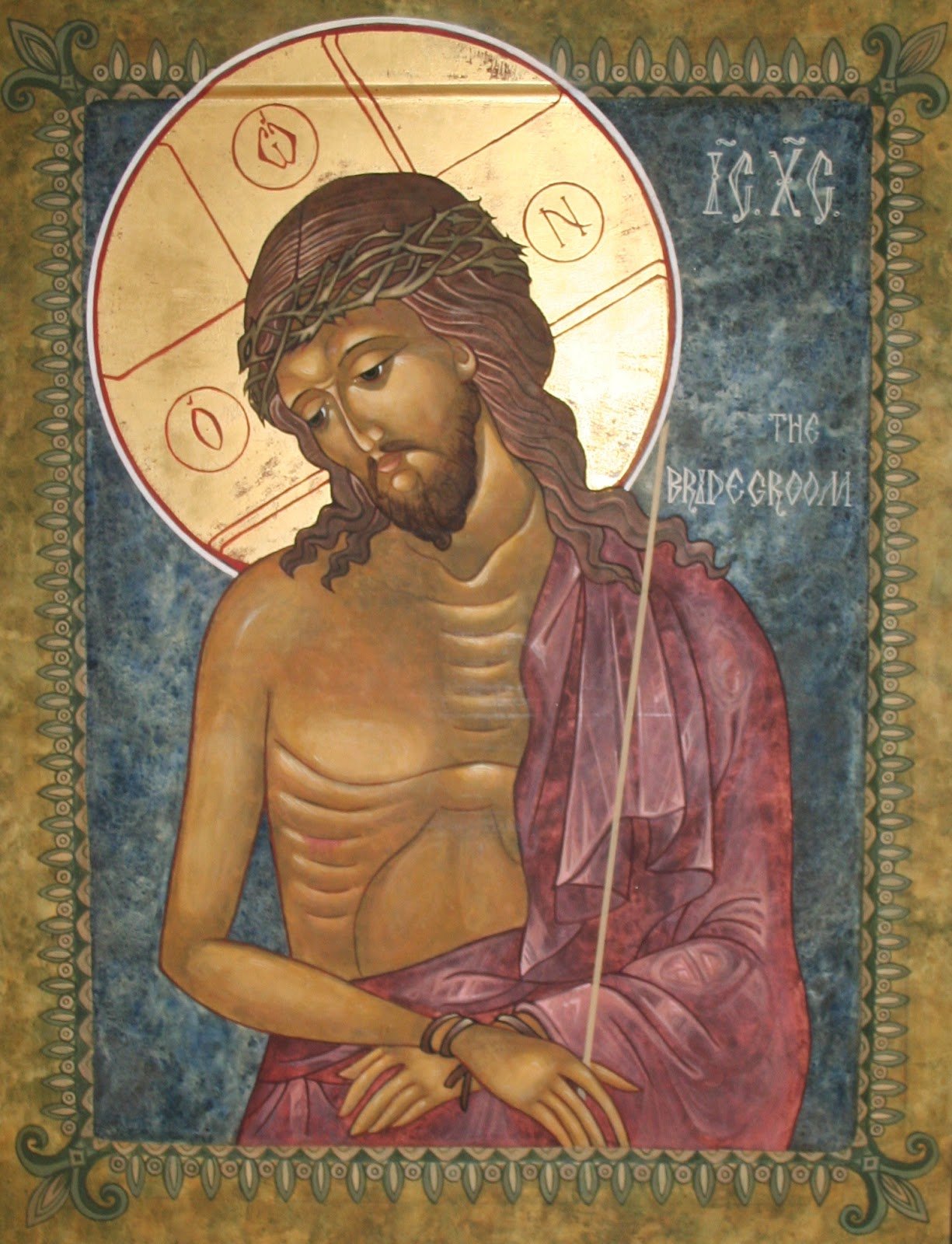
Icon of Christ the Bridegroom. January 16, 1084. Author unknown. https://commons.wikimedia.org/wiki/File:Christ_the_Bridegroom_Icon.jpg
St. Dominic left little by way of written word, which makes his May 1220 letter to the Madrid Dominican sisters a tiny treasure. In it, he exhorts the sisters:
Fight the good fight, my daughters, against our ancient foe, fight him insistently with fasting, because no one will win the crown of victory without engaging in the contest in the proper way.
During this Holy Week, I think we should embrace St. Dominic’s exhortation to fast as being directed to us, and do more than the minimum.
The Sixth Rule of Lay Dominicans echoes St. Dominic and points to a hidden source of strength to prayer and preaching. But the line is easy to overlook in the middle of Paragraph 10 of the Rule, which refers to the “chief sources from which the lay members of St. Dominic draw strength to advance in their proper vocation.” In the list of chief sources is “conversion of heart according to the spirit and practice of evangelical penance.” (Sixth Rule, Par. 10.e. (emphasis added).) Paragraph 10.e. in the Rule is key: conversion of heart through evangelical penance.
Paramount to evangelical penance is fasting. The Gospel according to St. Matthew informs us that Our Lord’s vision of how His followers are to live includes fasting: “When you fast ….” Matthew 6:16-17. Note that it was not a matter of whether we fast, but when we fast. He assumed the necessity of fasting by ignoring any notion of “if.” It is not an if; rather, it is when. And when is it that Jesus’ followers would fast? “[W]hen the bridegroom is taken away from them, . . . then they will fast.” Matthew 9:15. And why does Jesus speak of fasting as something fundamental for His followers, and the Dominican Rule speak of evangelical penance as a chief source from which to “draw strength”? Because there is a power in fasting not found elsewhere. “This kind [of demon] can go out by nothing, but by prayer and fasting.” Mark 9:28. Prayer is buttressed by fasting and preaching made effective because fasting involves a conversion of heart, one immersed in humility that recognizes and invokes the almighty power of God. It recognizes that we are powerless of ourselves. It empties us of all that is not Him, and enkindles a desire for Him, for ourselves and others. It purifies, orders the will, and quiets our lower appetites. Fasting makes us powerful because it transforms us into living holocausts before the throne of God.
The Lay Dominican Rule speaks of Lay Dominicans sharing in the Order’s “apostolic mission, by study, prayer and preaching according to the state proper to lay persons.” That sharing is founded in evangelical penance, as seen above, and is reinforced by prior iterations of the Lay Dominican Rule. For example, the First Rule instructed that members were to fast daily from the first Sunday of Advent until Christmas, and again from Quinquagesima Sunday until Easter, and also every Friday throughout the year. (Ch. XII.) The 1923 Rule prescribed fasts and abstinences on the vigils of the Holy Rosary, St. Dominic, St. Catherine, and exhorted members to fast on all Fridays. (Ch. VIII.) The 1923 Rule’s Chapter VIII on fasting was placed before the chapters on active works and preaching. The logic in the layout is clear. Preaching is lifeless if one’s heart has not been converted in penance.
The current Lay Dominican Rule’s layout has a similarity in that it describes “evangelical penance,” which includes fasting, as a “chief source.” We all want power in our spiritual lives, our example, our words. The vitality lies in our union with Jesus, and the Rule points to a fundamental truth of that union, which is that hearts (ours and others) must be converted through evangelical penance, what Our Lord instructed that we embrace.
“The time will come when the friends of the Bridegroom will fast ….”
Holy Week - it’s time.
-Anthony Alt
Receive God’s Word
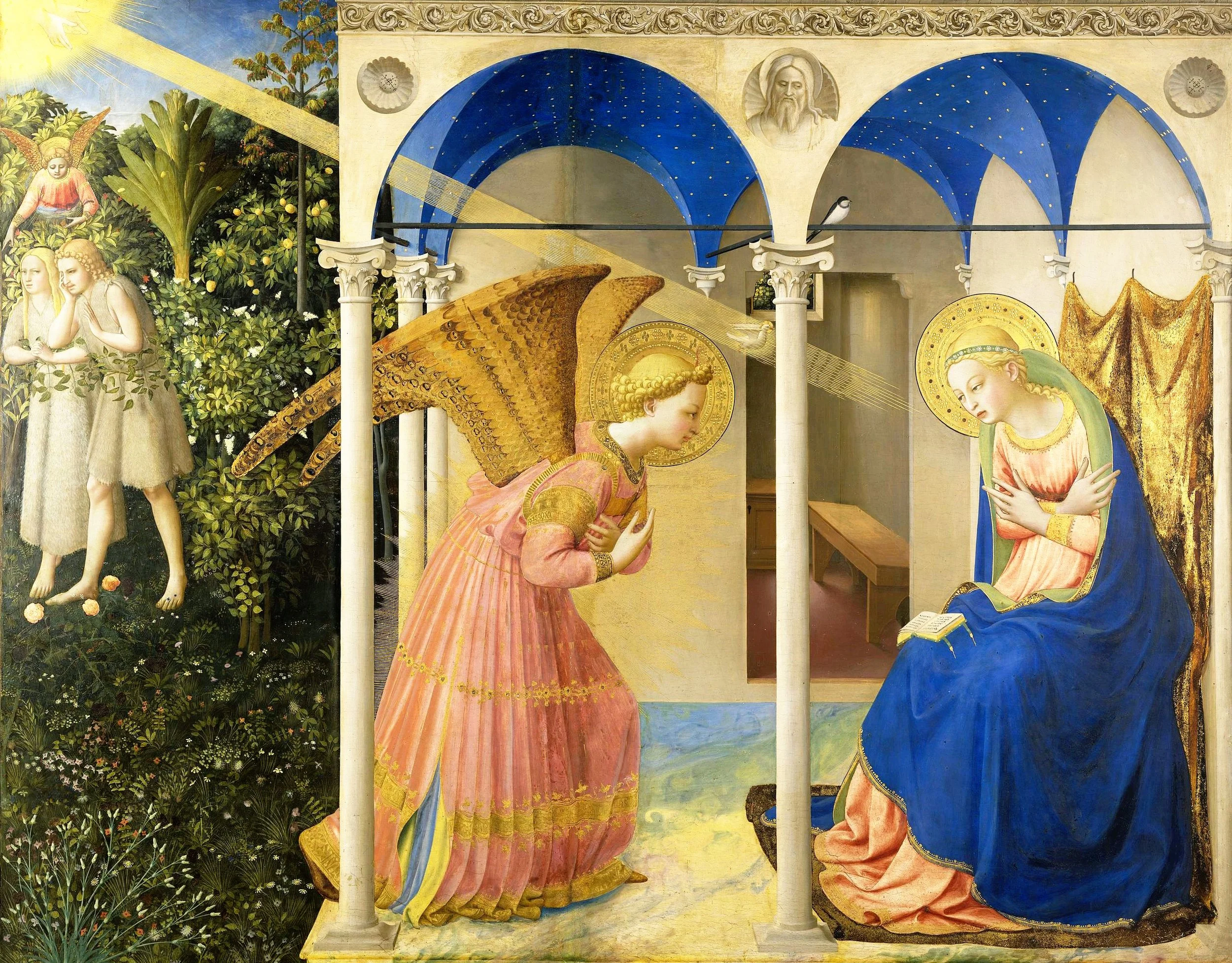

Fra Angelico. The Annunciation. https://commons.wikimedia.org/wiki/File:Fra_Angelico_-_The_Annunciation.jpg

By Mr. Joey Odell, O.P.
As we approach the Solemnity of the Annunciation, I want to invite you to consider this great event. The moment that opened the door to Christmas. In this painting, Fra Angelico shows us how Mary was disposed to the reception of the Word. Mary’s virtues extolled in this painting can serve as examples for us to follow as we prepare for the reception of the Word this Christmas.
We see a ray of light coming from Heaven, directed at Mary. The ray contains a dove, symbolizing the Holy Spirit overshadowing her. With how profoundly Mary’s head is bowed, you can see the ray reaching towards both her head and her heart. Medieval and Byzantine Annunciation art sometimes depicts the Holy Spirit—often as a dove on a ray of light—directed toward Mary’s ear, echoing the tradition of conceptio per aurem (‘conception through the ear’).¹ That is, the Incarnation occurs in and through Mary hearing and accepting Gabriel’s message. There’s a beautiful metaphor here: in order for God’s Word to penetrate both head and heart, our heads must be bowed in humility, acknowledging our dependence on God.
Look at her hands. They are cradling her belly. I would argue that this gesture symbolizes the theological virtues. The hands are open, accepting in faith the words of the Angel. They are cradling, anticipating in hope the baby she will soon be holding. Cradling of course is also the natural, loving embrace of a newborn. So we have in this gesture faith, hope, and love.²
Mary is seated in the portico, a kind of front porch. She sits on a lush blanket. There’s a bird that’s joined her. She’s reading a book. Mary is at leisure - not merely laying about. She has found a comfortable, peaceful place. Prior to the angel’s arrival, she was alone, and undistracted, save for the bird. I think many of us also enjoy sitting on our porches, reading books. To prepare ourselves for the reception of the Word, we, likewise, should take some time to engage in leisure. We should spend some time in a comfortable place in a solitude that eliminates distraction. I imagine myself with a good book and a hot cup of coffee.
Lastly, it’s important to note what she was reading. She is reading Scripture.³ Fra Angelico included this anachronistic technology in his painting to illustrate that Mary would have been familiar with the Scriptures. It’s unlikely she would have had any kind of written document in her home, but she would have memorized Scripture to fulfill the law: “And these words that I command you today shall be on your heart. You shall teach them diligently to your children, and shall talk of them when you sit in your house, and when you walk by the way, and when you lie down, and when you rise (Duet 6:6-7).” She would be very familiar with Scripture, hearing it read regularly in the Synagogues and at the Temple. And she would be keenly aware of the stories of Passover, Esther, and so many more that are retold in Jewish festivals throughout the year. Like all faithful Jews, she would be longing for the Messiah, wondering what he will be like. In this image, she is meditating on the Scripture, likely on the Messianic prophecies, pondering how they might be fulfilled…hoping. And she receives through the words of Gabriel something she couldn’t have ever imagined.
So, I implore you, be like Mary. Carve out some time in your days before this Solemnity. Find a comfortable spot, free of distraction. Meditate on Scripture. Dispose yourself to the reception of the Word. You might be surprised by what a little bit of leisure can give you…
¹For more details about conceptio per aurem, see the following:
https://aleteia.org/2017/03/24/the-deep-symbolism-of-annunciation-images/
https://produccioncientifica.ucm.es/documentos/5d399a352999520684462041?lang=en
²Grace Johnstone considers Mary’s posture as “protectively close,” indicating an "interminable moment of tension.” Artistic interpretation can very significantly, so my opinion here is but one of many. However, it seems to me that the angel bears the same posture as Mary, and there’s no reason why the Angel Gabriel would be in a protective posture. Rather, in mirroring Gabriel, I would argue that Mary is showing a posture of receptivity: hearing and accepting Gabriel’s words. That is to say, a posture of faith. https://ahva.ubc.ca/wp-content/uploads/sites/37/2016/05/9_120208_121212.pdf
³Mary reading a book as a symbol of her devotion to the Law, the prophets, and Scripture in general became a recurring motif in medieval art.
https://introducingmedievalchristianity.wordpress.com/2019/07/08/medieval-annunciation-symbolism/
https://diglib.library.vanderbilt.edu/act-imagelink.pl?RC=56337

Dominican Saints and Blesseds
Giovanni Battista Tiepolo. The Virgin Appearing to Dominican Saints (detail). Wikimedia Commons, commons.wikimedia.org/wiki/File:Giovanni_Battista_Tiepolo_-The_Virgin_Appearing_to_Dominican_Saints(detail)_-_WGA22283.jpg.
_-_WGA22283.jpg)
Giovanni Battista Tiepolo. The Virgin Appearing to Dominican Saints (detail). Wikimedia Commons, commons.wikimedia.org/wiki/File:Giovanni_Battista_Tiepolo_-The_Virgin_Appearing_to_Dominican_Saints(detail)_-_WGA22283.jpg.
ST. DOMINIC – St. Dominic was a Castilian priest and canon who was born in 1170. While on a mission with his bishop, Diego, he encountered Cathar heretics. Dominic and Bishop Diego started a mission in the south of France to convert them back to the Church. In 1215, Dominic sought approval of Pope Innocent III to formally start a religious order dedicated to preaching against heresy. He dedicated his remaining years to helping administer and grow his nascent order. He died on August 6, 1221 and was canonized in 1234.
ST ALBERT THE GREAT – Albert was born somewhere around the year 1197 in Bavaria. He was educated at the University of Padua and joined the Dominican Order in the 1220’s. He would later teach at the University of Paris, where he found his most famous student, St. Thomas Aquinas. He briefly served as a bishop and was then charged with preaching the Eighth Crusade. He was a scientist, philosopher, theologian, writer, and diplomat. He died in 1280, beatified in 1622, and canonized in 1931.
ST THOMAS AQUINAS – Thomas was born in 1225 in Sicily. He began studies in Naples. There, he was introduced to the Dominicans and decided to join them. His family resisted, and he was imprisoned by them for almost a year, until he escaped. After joining the Dominicans, he went to Paris and studied under St. Albert. His classmates called him “dumb ox” because he didn’t say much, but he would become a gifted theologian and wrote many important works, including the Summa Theologiae. A mystical vision shortly before his death caused him to stop writing more, saying that all he had written seemed as if straw. He died on March 7, 1274, was canonized in 1323, and declared a Doctor of the Church in 1567.
ST. CATHERINE OF SIENA – Catherine was born in 1347 in Siena. She dedicated her life to God at an early age, having received numerous mystical visions from an early age. Her parents wanted her to marry, but she resisted, eventually becoming a Dominican tertiary, continuing to live at home though she never married. She experienced a “mystical marriage” to Jesus, and devoted herself to acts of charity around Siena. She would later travel parts of Italy, advocating for clergy reform and had dictated many letters (Catherine herself was illiterate). She also received the Stigmata. She also served as a diplomat. She died on April 29, 1380, was canonized in 1461, and named a Doctor of the Church in 1970.
ST. MARTIN DE PORRES – Martin was born in 1579 in Peru, the illegitimate son of a Spanish noble and a freed slave. He was apprenticed to a barber-surgeon after his mother was unable to support him. While under Peruvian law he couldn’t formally join a religious order, he was eventually allowed to take vows in the Third Order and later became a lay brother. He became well known for his works among the poor and later a healer at an infirmary. He was known to have performed several miraculous cures. He died on November 3, 1639 and was canonized in 1962.
ST. ROSE OF LIMA – Rose was born in Peru in 1586. Growing up, she began fasting and abstaining from meat at a young age and rejected all suitors. Her father gave her a room in the house, which she rarely left except to attend church. Forbidden by her father from becoming a nun, she entered the Third Order and slept only a couple hours a night to better devote herself to prayer. She also sold lace and embroidery to the poor. She died on August 24, 1617 and was canonized in 1671.
ST PIER GIORGIO FRASSATI – The Order’s newest saint, Pier was born in 1901 in Turin. From a young age, he showed a generosity to help others, including giving his shoes to a mother and child who showed up to his family’s house begging. He had a fondness for practical jokes and was dedicated to social action, including opposing fascism. He entered the Third Order in 1922. He developed a reputation as a mountaineer and athlete. He died of tuberculosis on July 4, 1925 and was canonized on September 7, 2025.
What is the Charism of a Lay Dominican?
_________________________________
“Be who God meant you to be, and you will set the world on fire.”
- St. Catherine of Siena, Lay Dominican and Doctor of the Church
__________________________________
The Dominican Order rests on a foundation over eight centuries old, anchored in the Sacred Tradition of our Church and our shared spiritual life.
1. Prayer
To pray is to commune with God through the Holy Spirit. For Dominicans, this includes the Liturgy of the Hours and a deep devotion to our Mother Mary through the Rosary. Prayer guides us back to what is Holy.
2. Study
We believe we are called to lifelong learning: of Scripture, theology, Church teachings, and more. We study through books, media, and discussions - not simply on an academic level, but to grow closer to God and take what we learned back to our community. Our studies prepare us to pass on the Gospel not in fear or ignorance, but in clarity and love.
3. Community
Our humanity has a universal need for community and connection. This need is honored as Lay Dominicans when we gather monthly and for special occasions to pray, learn, and grow in our faith together in a supportive environment. In these gatherings, you can find diversity in background, culture, education, and family dynamics - but also a shared joy for charity and community. We encourage each other through the seasons of life, walking together in a path we strive towards Christ.
4. Preaching
Every Dominican is a preacher - but how do we define it? Preaching isn’t only from an altar or through a homily. It can also be through a life of service, or in parish ministry, or teaching, etc. Or simply being ready to answer when we are genuinely asked, “What do you believe?”
“Preach the Gospel at all times, and if necessary, use words.”
- commonly attributed to St. Francis of Assisi
So how do we live out these pillars, as charisms, as Lay Dominicans?
We walk with one foot in the Order and one foot in the everyday world - as singles, married people, parents, professionals. We live a Dominican spirituality but within an ever-changing society.
We support each other in local chapters, like our Holy Rosary Chapter in the Province of St. Albert the Great, not just during monthly gatherings, but through the actions of daily life: when we implement the four pillars, with our charisms, in our community - we are choosing love and mercy. We recognize the inherent dignity of every person we come across as an opportunity to be instruments of Jesus’ love by seeing Him in our fellow creations.
Jesus once said:
“Then the righteous will answer him, ‘Lord, when did we see you hungry and not feed you, or thirsty and not give you something to drink? When did we see you a stranger and not invite you in, or needing clothes and not clothe you? When did we see you sick or in prison and not go to visit you?’
And he will reply, ‘Truly I tell you, whatever you did not do for one of the least of these, you did not do for me.’” - Matthew 25:44-45
We believe that to be Dominican is to serve with intention - and that service can be through various forms, depending on your vocation and the charisms the Holy Spirit has given you. But no matter what, at the root, is:
Truth spoken with love.
To love God through loving others.
And to remember that God does not call the qualified - He qualifies the called.
By Katharina Locke
How Do I Become a Lay Dominican?
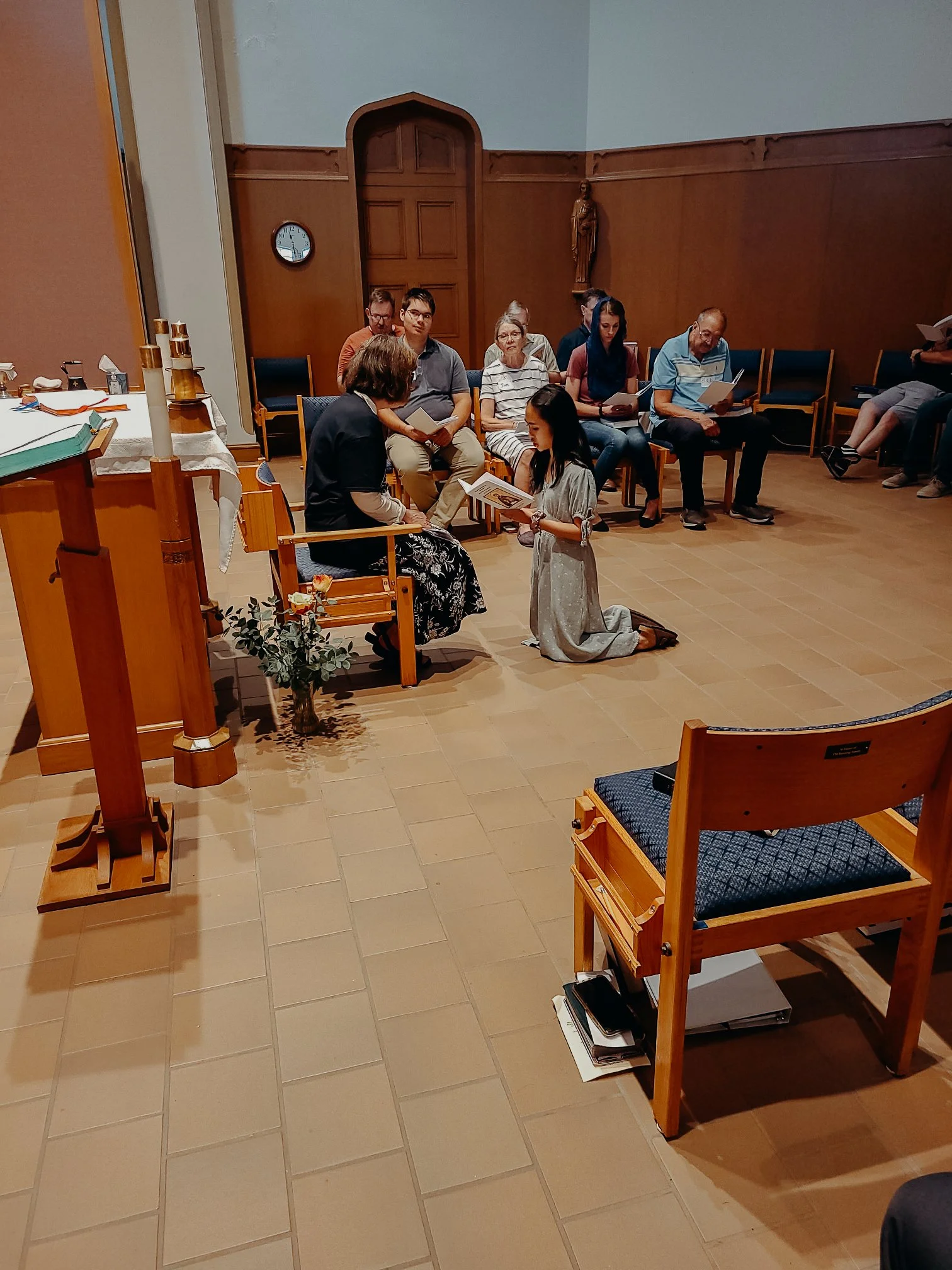
Called by the Holy Spirit, many seek to become a Lay Dominican, so that they can follow the examples of Saint Dominic, Saint Catherine of Sienna, and many other Dominican saints. Many seek to live lives of contemplation and mission, informed by the spiritual tradition of the Dominican Order. Still more seek out the Dominican Laity for community, accountability, and obedience to a Rule that orients you toward virtue, the proclamation of truth, the defense of justice and freedom, and the proclamation of the Gospel for the salvation of souls. The process to become a Lay Dominican takes years to complete. Here's the typical process:
Initial Steps:
Contact a local Dominican Lay Fraternity.
Attend a few meetings and events to learn about Dominican spirituality and charism.
Meet with current members and/or the religious assistant (usually a Dominican friar).
Once you have completed these initial steps, you will be invited to Formation.
Formation Period: The formation typically involves several stages over 4-5 years:
Inquiry Formation - A six month period of formation in preparation for Reception that includes learning about St Dominic and the Four Pillars of Dominican Life. At Reception, you formally and publicly enter into the Order and Fraternity, receive the White Scapular, and assume a Dominican patron saint. At this point, you are only making a commitment to participating in formation. You can discern out at any time.
Candidacy Formation - A one year period of formation in preparation for making First Profession, including learning about the Rule, Dominican history, spirituality, and practices. At First Profession, also called Temporary Profession, you formally and publicly make a promise to follow the Rule of the Lay Fraternities of Saint Dominic for three years.
Temporary Profession Formation - A three year period of formation where you undertake a deeper study of Dominican saints, theology, and Dominican Spirituality in preparation for making Perpetual Profession. At Perpetual Profession, sometimes called Final Profession, you formally and publicly make a promise to follow the Rule of the Lay Fraternities of Saint Dominic for the rest of your life.